
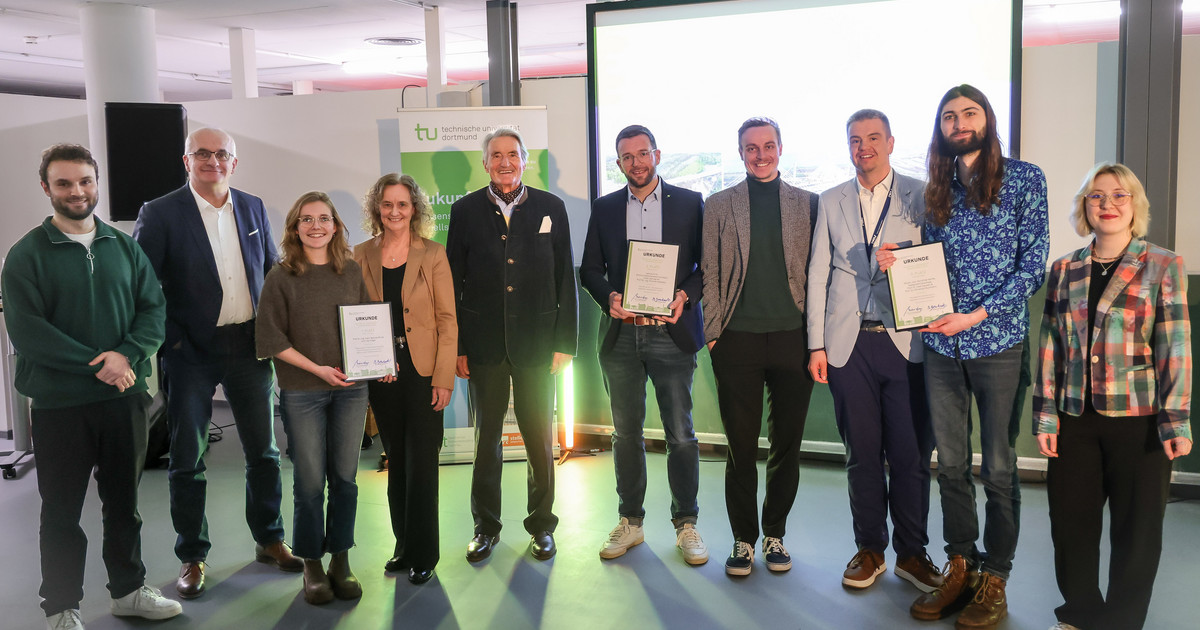
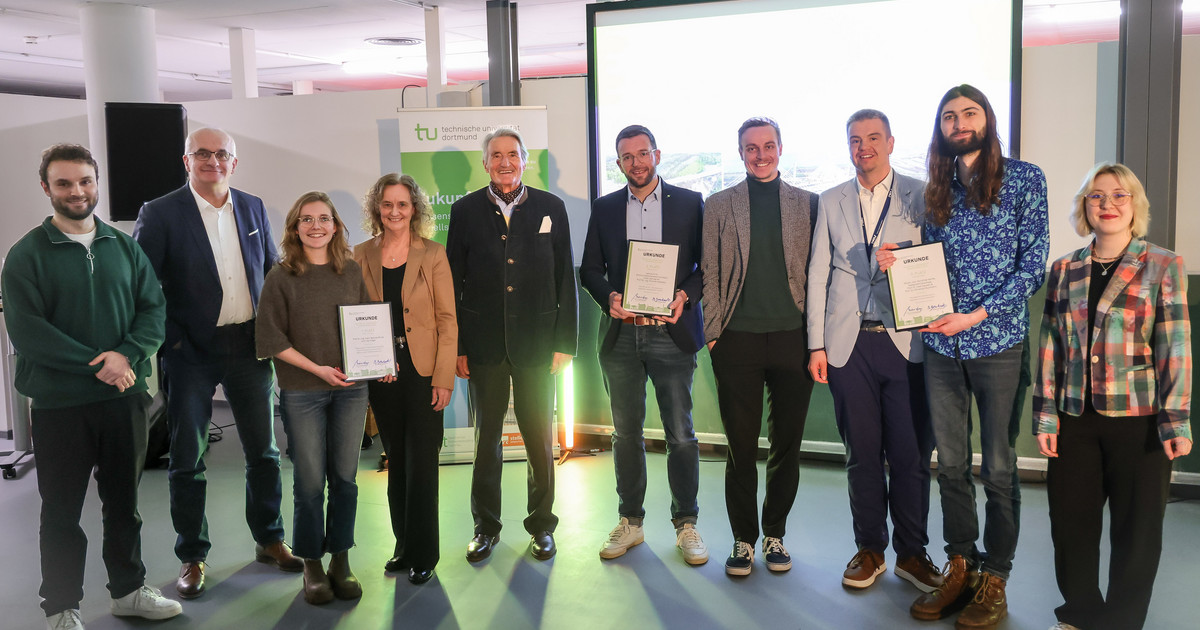
Professor Manfred Bayer, President of TU Dortmund University, welcomed the many guests in the Center for Entrepreneurship & Transfer (CET) and congratulated the award winners selected by the CET’s Research Transfer Advisory Board. The prize is presented every two years. The funds for it, €10,000 in total, are donated by Dr. Michael Brenscheidt, an attorney for commercial law in Dortmund, in recognition of special achievements in research transfer and to support new business ideas and collaborations with partners from practice.
The prizewinners
Lisa Kröger and Professor Bettina Brune from the Chair of Steel Construction at the Department of Architecture and Civil Engineering, who convinced the jury with their practice-oriented concept for repairing steel bridges without closing them, won first prize, which is worth €6,000. In their project, the two civil engineers defined criteria for injection screws for the first time and corroborated both the technical feasibility and the economic advantages in practice. Together with a panel of experts from science and industry, they successfully transposed the concept into national and European guidelines. This means that the process can be applied in Germany with immediate effect – not only in bridge maintenance but also in general construction.
“5G.NRW vor Ort” (5G.NRW On Site), a project by Stefan Böcker and the team from the Chair of Communication Networks (ComNets) at the Department of Electrical Engineering and Information Technology of TU Dortmund University, took second place and was awarded €3,000. The scientists are closing the gap between theoretical 5G research and the practical use of private campus networks with a three-phase model. The team has developed “Campus Network Plan”, a free tool that estimates the application fees for a planned network and pre-completes the application forms. In the frame of 5G campaign days on site, the researchers enable visitors to their mobile lab to gather practical experience and make it possible to evaluate individual network performance in day-to-day operations via a technical deep dive. The aim is to transfer the model to 6G at some point in the future.
Third prize, worth €1,000, went to “Strategic Network Planning for Seaport Hinterland Transportation”, a project by Niklas Jost and his colleagues at the Institute for Transport Logistics (ITL) and the Chair of Discrete Optimization at the Department of Mechanical Engineering. Together with their industrial partner, DB Schenker, the team has developed a software solution that automates complex routing decisions in global supply chains. The system not only saves time and money; it also serves as a strategic instrument for simulating network structures where a single decision simultaneously influences all others.