
[]
Home response.text()) .then(data => new DOMParser().parseFromString(data, “text/html”)) .then(dom => dom.querySelector(“div.uos-sitemap”)) .then(sitemap => getBreadcrumbsFromSitemap(sitemap)) .catch(() => getBreadcrumbsFromPath()) .then(breadcrumbs => buildBreadcrumbsHtml(breadcrumbs)) function findElementToStartFrom(sitemap) { let element = sitemap.querySelector(“a[href='” + windowPath + “?’]”) || sitemap.querySelector(“a[href='” + windowPath + “‘]”) if (element) { return element } let pathParts = windowPath.split(“/”).filter(part => part !== ”) for(let i = pathParts.length; i >=1 ; i–) { let path = (‘/’ + pathParts.slice(0, i).join(‘/’)) let element = sitemap.querySelector(“a[href='” + path + “‘]”) || sitemap.querySelector(“a[href='” + path + “/index.page’]”) || sitemap.querySelector(“a[href='” + path + “?’]”) || sitemap.querySelector(“a[href='” + path + “/index.page?’]”) if (element) { return element } } throw new Error(“Can’t find starting element in sitemap”) } function getBreadcrumbsFromSitemap(sitemap) { let breadcrumbs = [] let element = findElementToStartFrom(sitemap); while (element) { breadcrumbs.push(makeBreadcrumb((new URL(element.href)).pathname, element.innerText.trim())) element = getParentLink(element) } let homeTitle = sitemap.querySelector(“h2”).innerText.trim() let homeUrl = sitemap.querySelector(“a”).href.trim() breadcrumbs.push(makeBreadcrumb((new URL(homeUrl).pathname), homeTitle)) return breadcrumbs.reverse() } function getBreadcrumbsFromPath() { console.log(“Building breadcrumbs from path”) let breadcrumbs = [] let pathParts = windowPath.split(“/”).filter(part => part !== ”) for(let i = 1; i char.toUpperCase()) breadcrumbs.push(makeBreadcrumb(url, title)) } return breadcrumbs } function makeBreadcrumb(url, name) { return {href: url.trim(), name: name.trim()} } function buildBreadcrumbsHtml(breadcrumbs) { let rootElement = document.querySelector(“#BreadcrumbListNavElem”) breadcrumbs.forEach(crumb => { if (crumb.href === windowPath) { return } let rootDiv = document.createElement(“div”) rootDiv.setAttribute(“typeof”, “ListItem”) rootDiv.setAttribute(“property”, “itemListElement”) rootDiv.setAttribute(“class”, “uos-breadcrumb-child”) let link = document.createElement(“a”) link.href = crumb.href link.setAttribute(“title”, crumb.name) link.setAttribute(“typeOf”, “WebPage”) link.setAttribute(“property”, “item”) let titleSpan = document.createElement(“span”) titleSpan.innerText = crumb.name rootDiv.appendChild(link) link.appendChild(titleSpan) rootElement.innerHTML += “>” rootElement.appendChild(rootDiv) }) } function getParentLink(element) { while (element.tagName !== “UL”) { element = element.parentElement if (!element) { return null } } return Array.from(element.parentElement.children).find(item => item.tagName === “A”) } ]]>
Published: 2026-07-20 13:54:00
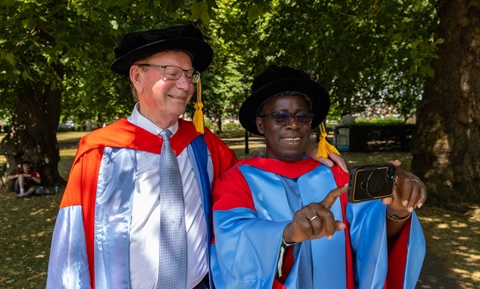 Professor Sir Stephen Holgate and Rosamund Adoo-Kissi-Debrah CBE
Clean air campaigner Rosamund Adoo-Kissi-Debrah CBE has been awarded an honorary degree by the professor who helped her push for change following her daughter’s death due to air pollution.
Professor Sir Stephen Holgate nominated Rosamund for an honorary Doctor of Science from the University of Southampton.
She was presented with the award at a graduation ceremony at the O2 Guildhall Southampton.
Rosamund is one of the world’s most prominent advocates for clean air. She founded the Ella Roberta Foundation following her daughter’s death due to asthma in 2013, when she was just nine years old.
Rosamund fought for seven years for a second inquest into Ella’s death to determine whether it was linked to air pollution. In a landmark decision in 2020, the coroner ruled that illegal levels of air pollution near their home were a significant contributor to Ella’s life-threatening asthma.
The family lived just 30 metres from London’s South Circular Road, one of the most polluted roads in Europe.
Ella remains the only person globally to have air pollution on her death certificate.
Professor Holgate, a world-renowned air quality expert, has worked closely with Rosamund for many years. He played a crucial role as a medical expert in Ella’s second inquest.
Rosamund said: “It is such an honour to be recognised in this way by such a prestigious science university like Southampton, and I really wouldn’t be here today without all the work that Professor Sir Stephen Holgate and I have been doing over the past decade.
“I have made it my life’s work to prevent other children from suffering the way that my daughter Ella did, and I hope to continue to raise awareness about the dangers of air pollution, and honour Ella’s legacy by saving millions of people’s lives.
“The soaring temperatures we have been experiencing recently are a stark reminder that air pollution, exacerbated by the heat, is the biggest environmental threat to human life. And as Stephen has often said, Ella was the canary in the coalmine, and whilst we cannot see the damage air pollution is doing to our bodies, we know that it is there and we owe it to Ella and all the children, to continue to fight to clean up the toxic air we breathe.”
Professor Holgate said: “As one of the world’s most powerful advocates for the fundamental human right to clean air, Rosamund Adoo-Kissi-Debrah is a profound inspiration. She exemplifies how one person’s immense tragedy can be transformed into a relentless, life-saving mission, championing the health and wellbeing of all, irrespective of background or circumstance.”
The University of Southampton’s groundbreaking new Institute for Medical Innovation (IMI) will bring together the greatest minds in medicine, computer science and engineering to tackle devastating diseases, including respiratory conditions.
To find out more about the IMI visit: fund.southampton.ac.uk/innovation/