
[]
Home response.text()) .then(data => new DOMParser().parseFromString(data, “text/html”)) .then(dom => dom.querySelector(“div.uos-sitemap”)) .then(sitemap => getBreadcrumbsFromSitemap(sitemap)) .catch(() => getBreadcrumbsFromPath()) .then(breadcrumbs => buildBreadcrumbsHtml(breadcrumbs)) function findElementToStartFrom(sitemap) { let element = sitemap.querySelector(“a[href='” + windowPath + “?’]”) || sitemap.querySelector(“a[href='” + windowPath + “‘]”) if (element) { return element } let pathParts = windowPath.split(“/”).filter(part => part !== ”) for(let i = pathParts.length; i >=1 ; i–) { let path = (‘/’ + pathParts.slice(0, i).join(‘/’)) let element = sitemap.querySelector(“a[href='” + path + “‘]”) || sitemap.querySelector(“a[href='” + path + “/index.page’]”) || sitemap.querySelector(“a[href='” + path + “?’]”) || sitemap.querySelector(“a[href='” + path + “/index.page?’]”) if (element) { return element } } throw new Error(“Can’t find starting element in sitemap”) } function getBreadcrumbsFromSitemap(sitemap) { let breadcrumbs = [] let element = findElementToStartFrom(sitemap); while (element) { breadcrumbs.push(makeBreadcrumb((new URL(element.href)).pathname, element.innerText.trim())) element = getParentLink(element) } let homeTitle = sitemap.querySelector(“h2”).innerText.trim() let homeUrl = sitemap.querySelector(“a”).href.trim() breadcrumbs.push(makeBreadcrumb((new URL(homeUrl).pathname), homeTitle)) return breadcrumbs.reverse() } function getBreadcrumbsFromPath() { console.log(“Building breadcrumbs from path”) let breadcrumbs = [] let pathParts = windowPath.split(“/”).filter(part => part !== ”) for(let i = 1; i char.toUpperCase()) breadcrumbs.push(makeBreadcrumb(url, title)) } return breadcrumbs } function makeBreadcrumb(url, name) { return {href: url.trim(), name: name.trim()} } function buildBreadcrumbsHtml(breadcrumbs) { let rootElement = document.querySelector(“#BreadcrumbListNavElem”) breadcrumbs.forEach(crumb => { if (crumb.href === windowPath) { return } let rootDiv = document.createElement(“div”) rootDiv.setAttribute(“typeof”, “ListItem”) rootDiv.setAttribute(“property”, “itemListElement”) rootDiv.setAttribute(“class”, “uos-breadcrumb-child”) let link = document.createElement(“a”) link.href = crumb.href link.setAttribute(“title”, crumb.name) link.setAttribute(“typeOf”, “WebPage”) link.setAttribute(“property”, “item”) let titleSpan = document.createElement(“span”) titleSpan.innerText = crumb.name rootDiv.appendChild(link) link.appendChild(titleSpan) rootElement.innerHTML += “>” rootElement.appendChild(rootDiv) }) } function getParentLink(element) { while (element.tagName !== “UL”) { element = element.parentElement if (!element) { return null } } return Array.from(element.parentElement.children).find(item => item.tagName === “A”) } ]]>
Published: 2026-07-21 08:41:00
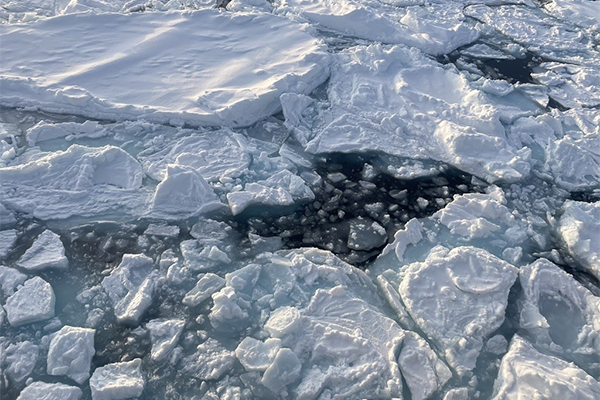
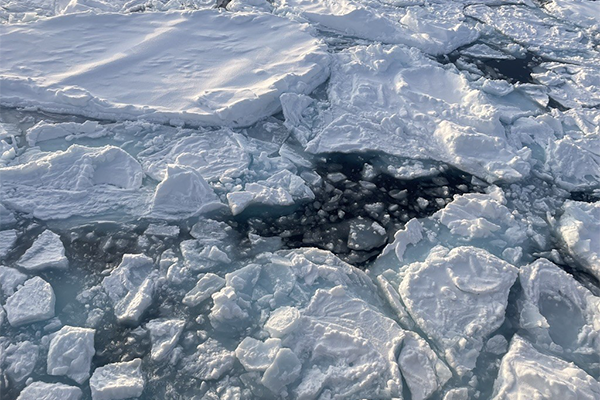 Credit Izzy White
New analysis shows that a ‘pause’ in Arctic winter sea ice decline seen in the early 2020s has ended following record lows in 2025 and early 2026.
The study, led by the University of Southampton in collaboration with the National Oceanography Centre (NOC), adds the most recent satellite observations to trends of sea ice coverage during the winter growth and peak phases of the Arctic sea ice cycle.
Previous analyses had suggested that the rate of Arctic winter sea ice loss had weakened in the early 2020s. But after adding the exceptionally low 2025 and 2026 winters to the record, the team found that 20-year trends had returned to a state of significant decline.
“This sharp drop changes the way we interpret recent Arctic winter sea ice change,” said Dr Duo Chan , lead author of the paper from the University of Southampton’s School of Ocean and Earth Science.
“What looked like a pause in the early 2020s now appears to have been a temporary slowdown within a longer-term decline associated with global warming.”
The study is published today in PNAS .
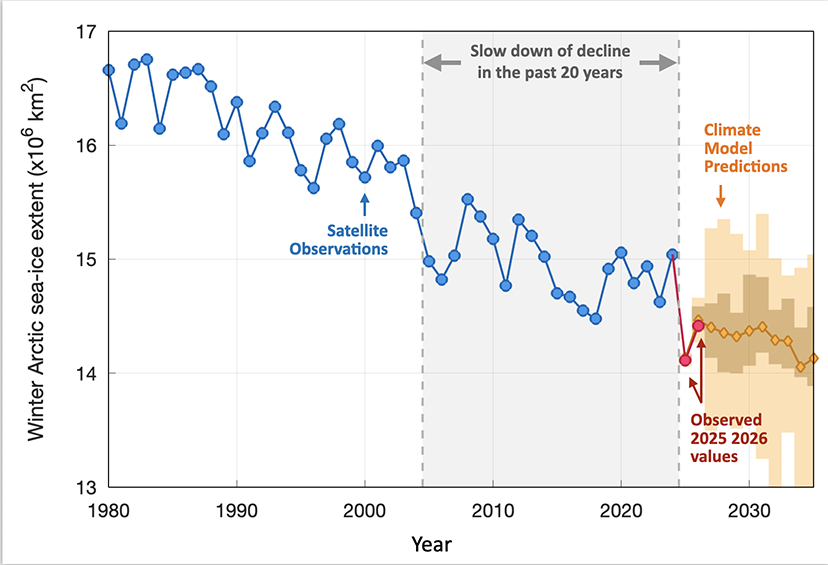 Winter arctic sea ice coverage dropped dramatically in 2025 after a period of the trend weakening.
Arctic sea ice is an important bellwether of climate change. Winter sea ice cover acts as a barrier between the relatively warm Arctic Ocean and the much colder winter atmosphere. Reduced winter ice allows more ocean heat and moisture to enter the atmosphere. This can affect pressure patterns, storm development and large-scale atmospheric circulation, impacting the weather further south.
Between 2024 and 2025, Arctic sea ice extent during the winter peak phase, from February to March, fell by 5.8%. This was the largest year-to-year wintertime drop in the satellite record, which began in 1978. In 2026, peak phase sea ice recovered slightly but remained the second lowest extent recorded.
To analyse the results further, the team compared what was being observed by satellites to simulated comparable events using the latest climate change models.
“By identifying these analogous events, we found that such a sharp drop in 2025 was unusual, but physically plausible under current Arctic warming,” said Dr Alessandro Silvano , co-author of the paper at the University of Southampton.
Analysing comparable events also allows researchers to anticipate what usually happens after a sharp winter sea ice drop like the one observed in 2025.
Professor Simon Josey, co-author of the study at the National Oceanography Centre, said: “The model analogues suggest that, under current levels of Arctic warming, Arctic winter sea ice is more likely to fluctuate around a lower level over the next few years than quickly rebound to early 2020s conditions.”
Dr Chan concluded: “Short-term recoveries can temporarily obscure the longer-term direction of Arctic sea ice change. The low winter sea ice extents in 2025 and 2026 clearly show that Arctic sea ice loss has not stopped — it is continuing in a warming climate.”
The study was funded by a UKRI Future Leaders Fellowship and the NERC.