
[]
Home response.text()) .then(data => new DOMParser().parseFromString(data, “text/html”)) .then(dom => dom.querySelector(“div.uos-sitemap”)) .then(sitemap => getBreadcrumbsFromSitemap(sitemap)) .catch(() => getBreadcrumbsFromPath()) .then(breadcrumbs => buildBreadcrumbsHtml(breadcrumbs)) function findElementToStartFrom(sitemap) { let element = sitemap.querySelector(“a[href='” + windowPath + “?’]”) || sitemap.querySelector(“a[href='” + windowPath + “‘]”) if (element) { return element } let pathParts = windowPath.split(“/”).filter(part => part !== ”) for(let i = pathParts.length; i >=1 ; i–) { let path = (‘/’ + pathParts.slice(0, i).join(‘/’)) let element = sitemap.querySelector(“a[href='” + path + “‘]”) || sitemap.querySelector(“a[href='” + path + “/index.page’]”) || sitemap.querySelector(“a[href='” + path + “?’]”) || sitemap.querySelector(“a[href='” + path + “/index.page?’]”) if (element) { return element } } throw new Error(“Can’t find starting element in sitemap”) } function getBreadcrumbsFromSitemap(sitemap) { let breadcrumbs = [] let element = findElementToStartFrom(sitemap); while (element) { breadcrumbs.push(makeBreadcrumb((new URL(element.href)).pathname, element.innerText.trim())) element = getParentLink(element) } let homeTitle = sitemap.querySelector(“h2”).innerText.trim() let homeUrl = sitemap.querySelector(“a”).href.trim() breadcrumbs.push(makeBreadcrumb((new URL(homeUrl).pathname), homeTitle)) return breadcrumbs.reverse() } function getBreadcrumbsFromPath() { console.log(“Building breadcrumbs from path”) let breadcrumbs = [] let pathParts = windowPath.split(“/”).filter(part => part !== ”) for(let i = 1; i char.toUpperCase()) breadcrumbs.push(makeBreadcrumb(url, title)) } return breadcrumbs } function makeBreadcrumb(url, name) { return {href: url.trim(), name: name.trim()} } function buildBreadcrumbsHtml(breadcrumbs) { let rootElement = document.querySelector(“#BreadcrumbListNavElem”) breadcrumbs.forEach(crumb => { if (crumb.href === windowPath) { return } let rootDiv = document.createElement(“div”) rootDiv.setAttribute(“typeof”, “ListItem”) rootDiv.setAttribute(“property”, “itemListElement”) rootDiv.setAttribute(“class”, “uos-breadcrumb-child”) let link = document.createElement(“a”) link.href = crumb.href link.setAttribute(“title”, crumb.name) link.setAttribute(“typeOf”, “WebPage”) link.setAttribute(“property”, “item”) let titleSpan = document.createElement(“span”) titleSpan.innerText = crumb.name rootDiv.appendChild(link) link.appendChild(titleSpan) rootElement.innerHTML += “>” rootElement.appendChild(rootDiv) }) } function getParentLink(element) { while (element.tagName !== “UL”) { element = element.parentElement if (!element) { return null } } return Array.from(element.parentElement.children).find(item => item.tagName === “A”) } ]]>
Published: 2026-07-23 10:14:00
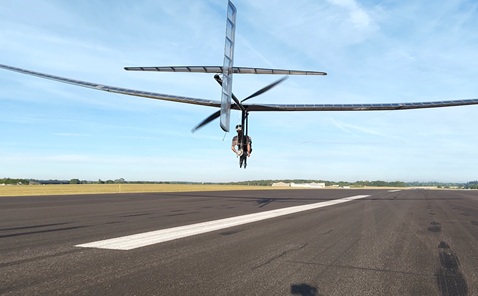
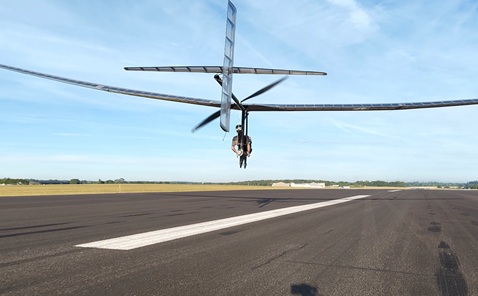 Leith Bowman flying AeroLazarus
Pedal-powered aircraft took to the skies above Hampshire in a nine-day contest to record the longest, fastest and most skilled flights.
It is the only competition of its kind outside of the famous Japanese International Birdman Rally.
A team from the University of Southampton emerged victorious, scooping both the top scoring aircraft and contest’s title, the Icarus Cup.
Third year aerospace engineering student Leith Bowman won the Icarus Cup for being the best pilot, and the Southampton AeroLazarus aircraft was the top scoring aircraft.
It’s the first time the Southampton University Human Powered Aircraft (SUHPA) society has won the cup since the team was established in 2018.
Organised by the British Human Powered Flying Club (BHPFC), the competition took place at Lasham Airfield near Basingstoke from 4 to 12 July and consisted of a series of challenges in endurance, speed and maneuverability.
Six pedal-powered aircraft took part this year, with spectators coming from across the UK as well as the Netherlands, France, Germany and the United States.
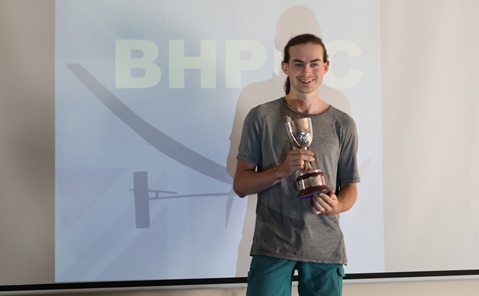 Leith Bowman with Icarus Cup. Credit BHPFC
Leith, 22, said AeroLazarus is more exciting to fly than many other human powered aircraft because the pilot is exposed to the elements rather than inside a cabin.
AeroLazarus is assisted by three ground crew who help accelerate it to 10mph. “Once the ground crew release the aircraft, I must pedal as hard as possible to accelerate the aircraft up to its flight speed of 20mph whilst also precisely controlling it to keep the wings level,” explained Leith.
The challenges for pilots included landing as closely as possible to a marked point, and a slalom challenge to cross the runway’s centre line as many times as possible over 500 metres.
“Winning the cup was a great feeling of accomplishment, having spent hundreds of hours building the aircraft,” said Leith. “This year’ s competition was great because everything went right, the aircraft performed perfectly and came home in one piece – a first for our team!”
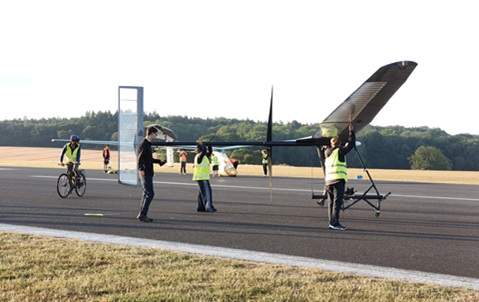 SUHPA ground crew handling the aircraft
Yaseen Reza, postgraduate researcher at the University of Southampton, co-founder of the SUHPA society, and media officer for the BHPFC, said: “Ever since we set up the SUHPA society there has been a design evolution every year and our aircraft has got better and better. It was really gratifying to see all the time and effort that has gone into the society lead to an award-winning aircraft.”
The Icarus Cup trophy was donated to the BHPFC by the Royal Aeronautical Society, ahead of the inaugural competition of the same name held in 2012.
Other participants of this year’s contest included London South Bank University, four private teams, and a number of students from the University of Strathclyde and Heriot-Watt University.
The SUHPA society will be taking its AeroLazarus aircraft to Farnborough Airshow this year, on Friday 24 July.